


A recent global survey by global cybersecurity company Kaspersky’s market research centre revealed that an overwhelming 81% of people, including Malaysians believe digitalisation will fundamentally alter families’ joint pastimes within the next decade. This shift points to a future where bonding is mediated by advanced technology, creating new rituals and challenges in equal measure.
The study was conducted in November 2025 with 3,000 respondents from 15 countries. (Argentina, Chile, China, Germany, India, Indonesia, Italy, Malaysia, Mexico, Saudi Arabia, South Africa, Spain, Turkey, UK, United Arab Emirates)
Screen time is family time, but it has its risks
In Malaysia, the survey suggests growing openness towards technology shaping everyday family routines. Around 54% of respondents say they would use AI tools to tell bedtime stories to their children, while 42% of them expect home robots to become part of family in the future. Beyond convenience, such technologies are increasingly seen as tools that could assist with childcare and companionship within digitally connected households.
While AI has the potential to enrich a child’s life, it necessitates vigilance. When children interact with AI, for stories or learning, parents must be proactive. Select services with strong privacy policies that do not unnecessarily store or misuse a child’s data or voice interactions and further enhance control with digital parenting assistants like Kaspersky Safe Kids to restrict content and balance screen time.
Parents would be well placed to treat AI interactions as a new digital playground where they can use parental controls to limit session duration, choose vetted, age-appropriate AI story platforms, and most importantly, maintain an open dialogue about what these stories are and how they are created. Explain to children that an AI is a tool, not a friend, and encourage them to report any strange or uncomfortable interactions, just as they would in the physical world.
The key is to ensure AI complements human interaction, not replaces the comfort of a parent’s voice.
Blowing out the digital candles
Another 43% of those surveyed predict family celebrations migrating to video call formats as a standard, not an exception, a trend accelerated by recent global events but now seen as a permanent fixture for dispersed families. In Malaysia, 56% of respondents believe that celebrating through video calls will become a common practice in the future. Meanwhile a daring 26% can imagine taking family vacations entirely in virtual reality. This sounds like the stuff of science fiction, but then 10 years ago, the type of generative AI being used today was not widely anticipated.
This fragmented outlook highlights that the future of family digital activity will not arrive as a uniform wave, but as a series of adoptions shaped by cultural openness and digital infrastructure. This evolving landscape presents new vectors for risk within the most intimate of spaces, the smart home.
Preparing the digital home for tomorrow’s family
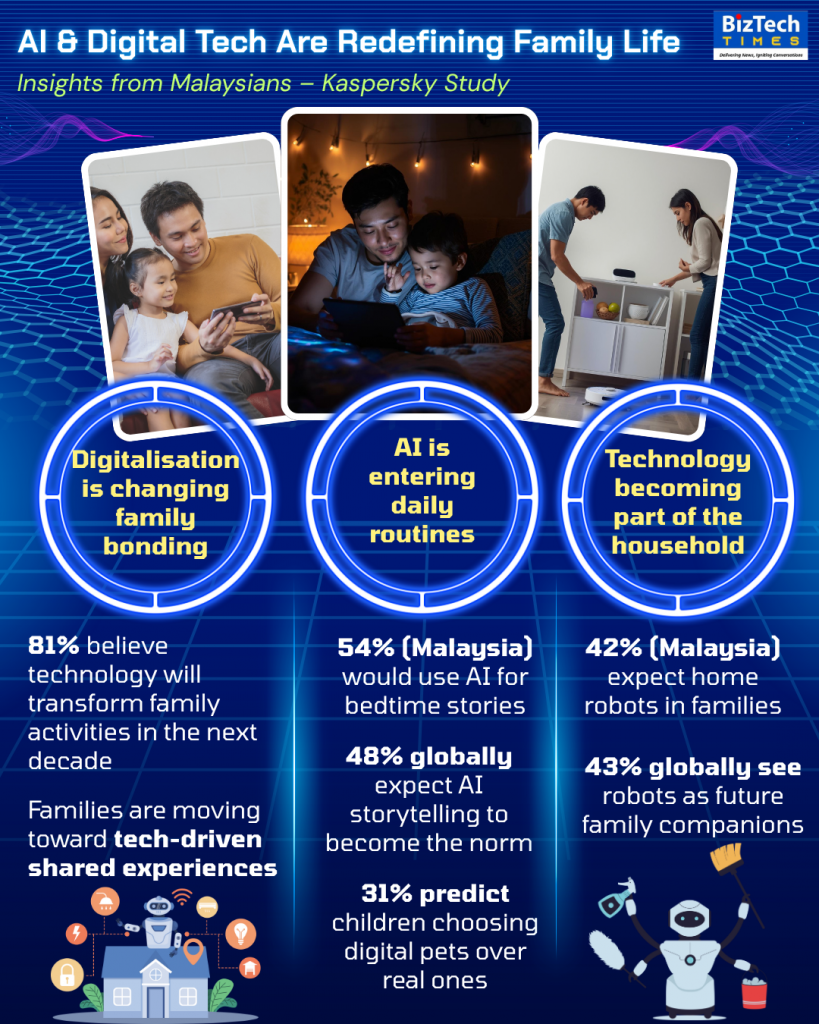
43% of respondents foresee home robots as family members. Moving beyond voice-activated personal assistants or autonomous vacuum cleaners, these would be embodied AI companions capable of tutoring, playing games, or providing companionship.
In the eyes of hackers, however, every new device, from a VR headset to a robot nanny, is a potential entry point. To keep things secure, change default passwords immediately, ensure all device firmware is regularly updated, and segment your home network. Use Kaspersky Premium with a Smart Home Monitor which scans users’ home Wi-Fi network 24/7, and shows a list of devices connected to it, including such details as device type, OS and IP address, and alerts when a new or unknown device connects.
As robots, AI, and VR devices become part of the family circle, security must be foundational, not an afterthought.
“What we observe is not just the growth of digital tools within households, but a shift in how families interact, learn and spend time together. As these digital experiences become more integrated into family routines, it is also increasingly important for parents to understand how these innovations shape children’s online environments and ensure that digital safety keeps pace with this growing convenience. Simple steps such as setting clear digital boundaries, using parental controls and choosing a trusted cybersecurity solution can help families enjoy the benefits of technology while developing safer digital habits at home,” said Chee Choon Hong, Consumer Channel of APAC at Kaspersky.
The accelerating pace of technology is not fragmenting the family but redefining its shared spaces. The future, as seen by the global majority, is one where digital and physical experiences blend to create new forms of togetherness, from a grandparent joining a birthday party via hologram to a child caring for a digital pet with a sibling across the globe. The challenge and opportunity lie in building secure digital environments with intention, ensuring they are safe, respectful, and ultimately, tools that bring us closer.