

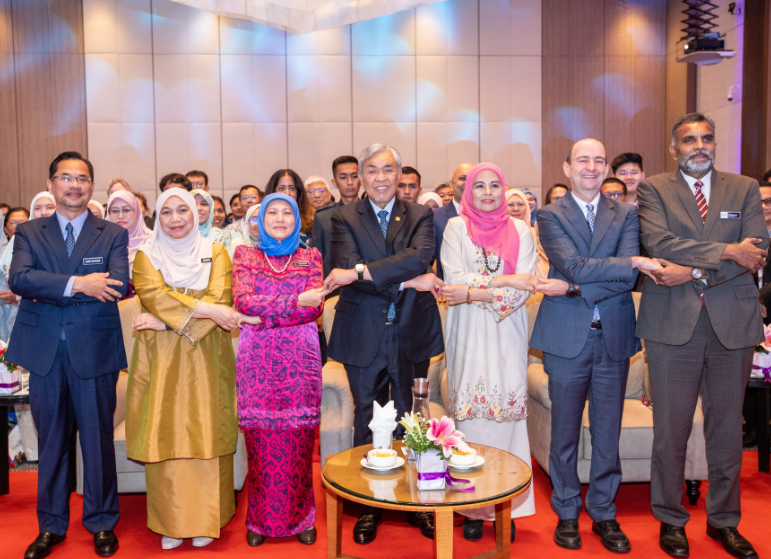
Minister of Women, Family and Community Development (third from the left), Robert Gass, UNICEF Representative in Malaysia (second from the right)
Themed “Empowering Children and Strengthening ASEAN’s Commitment to a Safer Digital Future”, the 2025 ASEAN ICT Forum on Child Online Protection brings together policymakers, technology and digital industry leaders, civil society and young people from across the region to confront growing online risks, share solutions, and shape emerging policies on child online safety.
The annual forum, hosted in Kuala Lumpur this year, reaffirms Malaysia’s leadership in advancing regional cooperation and signals the region’s continued momentum in safeguarding children’s rights online.
Co-hosted by Malaysia’s Ministry of Women, Family and Community Development (MWFCD) and Ministry of Communications, in collaboration with ASEAN and supported by UNICEF, the Forum also benefited from the generous support of Safe Online, UNICEF Australia, and the Australian government including: the eSafety Commissioner; the Attorney-General’s Department; Australian Aid; and the Australian High Commission. Together, these partnerships underscore ASEAN’s shared commitment to a safer digital future for every child.
Co-designed with UNICEF’s Young People’s Advisory Group, the Forum ensures that children’s voices and lived experiences shape every discussion – from digital wellbeing and mental health to inclusive online environment for children with disabilities.
“Technology is reshaping how children learn, connect and discover the world,” said Datuk Seri Nancy Shukri, Minister of Women, Family and Community Development. “But alongside opportunities come real risks – cyberbullying, misinformation, grooming, exploitation, and the emotional toll of being ‘always online.’ These challenges do not stop at borders; our solutions cannot stop at borders either. We must stand together, share what works, and build safer digital ecosystems across the region.”
“Safety must be built into every click, every platform, every product and every policy,” said Robert Gass, UNICEF Representative in Malaysia. “Children have the right to be safe and protected online. That safety begins by ensuring children are not just consulted but included at the decision-making table. Real progress happens when governments, industry, schools, and families all play their part. Protecting children online isn’t the job of one actor — it’s our shared accountability.”
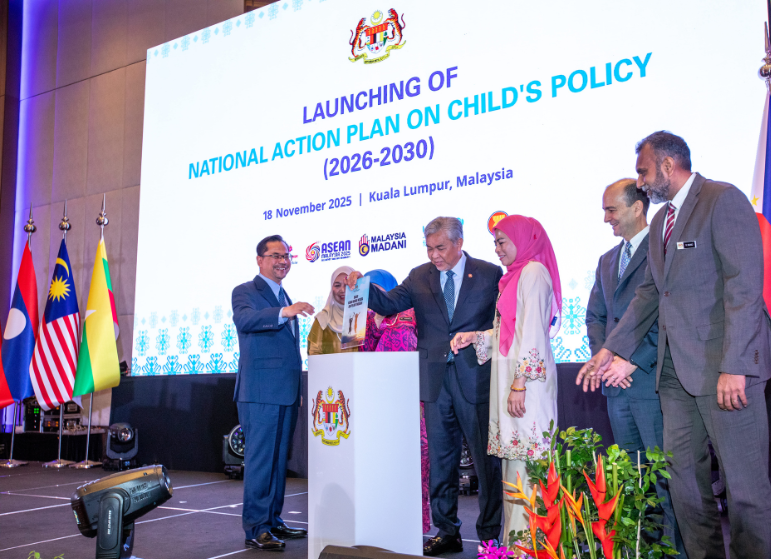
National Child Policy Action Plan (2026-2030)
The Forum also marked the launch of Malaysia’s National Child Policy Action Plan (2026-2030), officiated by Datuk Seri Dr Ahmad Zahid Hamidi, Deputy Prime Minister of Malaysia, reaffirming the nation’s commitment to advance every child’s right and protection in line with the Convention on the Rights of the Child (CRC). The Action Plan translates policy into concrete measures to strengthen child protection systems, promote digital literacy, and address online risks such as exploitation and abuse — complementing the ASEAN ICT Forum’s regional agenda in aligning national priorities with ASEAN’s shared commitment to build safer digital spaces for every child.
“We must protect children without limiting their potential,” said Ahmad Zahid, “Malaysia holds to one clear principle. We do not want to disconnect them from technology — we want to empower them to use it safely and confidently. A child must be free to learn, to explore, and to imagine, but free safely, not free to be exploited. This is why Malaysia is strengthening a whole-of-government approach that unites ministries, regulators, educators, parents, communities, and technology companies. We believe that safety and freedom must coexist. A child cannot thrive if they are unsafe, and they cannot succeed if they are unprepared. Our duty is to ensure they have both protection and opportunity”.
In Malaysia, online child sexual exploitation and abuse remains a growing concern. According to the Disrupting Harm study one in 25 children aged 12 to 17 in Malaysia has experienced online sexual exploitation and abuse, including being blackmailed, coerced or having their private images shared without consent. Yet, only three per cent of Malaysian school children say they would seek help through existing reporting channels. These findings serve as a wake-up call for all sectors to act faster and design a digital world that protects children by default, not by exception.
The Forum aims to bridge gaps and offer solutions by championing safety-by-design principles and co-creating child-friendly technology and apps that put children’s rights, needs and voices at the heart of every digital product, while ensuring that children who experience harm online can access the care, counselling, and support they need.
As ASEAN strengthens its collective response to protect children online, the Forum marks another step toward building a region where every child can participate, learn and thrive safely in the digital world. The discussions at the 2025 ASEAN ICT Forum will support implementation of the next Regional Plan of Action on Child Online Protection (2026–2030), setting a shared direction for governments, industry and communities to work hand in hand with children, creating digital spaces that are not only safe by design but empowering by choice.