


Many people are searching for love or just companionship by using dating apps in today’s fast paced and increasingly digitized society. About 360 million people regularly use dating apps, and these apps now drive total global revenues of more than $6 billion.
Tinder remains the dominant dating app, but only controls about 30% of total revenues. There are still plenty of competitors, including niche apps that focus on alternative dating experiences. In fact, the average user regularly engages with at least two different services. This means that users are already well-positioned to drop the apps that don’t live up to expectations. None of these digital dating experiences would be possible without the global, interconnected digital infrastructure that many people take for granted. As they swipe away, most users don’t stop to think about the invisible foundation of IT infrastructure that makes these apps possible. This includes data centers, network connections, cloud services and more. And the better that infrastructure is, the better the user experience will be.
Of course, data centers do not control the quality of profiles you will find on any particular app. But what they do control is how quickly and reliably you can find and connect with other users. There are many steps that have to happen between a swipe and a match, and all those steps happen in and around data centers.
Love is local—and so is dating app infrastructure
Dating apps require robust infrastructure at the digital edge—the places with high concentrations of end users. That’s because they need low-latency connectivity to prevent delays and ensure the quality of the user experience. Since latency is an inevitable byproduct of distance, keeping latency low requires proximity between end users and the digital infrastructure that supports the app.
When they make a match, users want to receive the alert as quickly as possible, from wherever they’re using the app. If data takes too long to move from the device to a distant data center or cloud region and back again, the delay could frustrate users and push them toward a different app.

Dating tends to happen within cities. The swiping model popularized by Tinder is based on the simple idea that you should be able to match with someone who lives near you, start chatting in a matter of seconds, and potentially even meet in person soon after. Because the user base for dating apps is concentrated in highly populated areas, these apps need digital infrastructure and services in those same locations. Without proximity, a high-quality user experience would be impossible.
For instance, if two users are based in Singapore, and the data center that supports the app is also in Singapore, then their data never has to leave the local area. This helps keep latency low, allowing the users to make a match in real time.
On the other hand, if the data center were located elsewhere, it would create a “hairpin” scenario, where traffic has to move long distances to reach the data center and then long distances back to the device. In this situation, latency would be a serious issue, and delays would be inevitable.
App providers need access to a distributed platform of digital infrastructure to ensure they’re able to support users in all the different cities they operate in.
Inside the dating ecosystem
Getting close to users in many different cities isn’t easy. Fortunately, dating app providers don’t have to work alone. When they deploy inside an interconnection hub, they will be able to quickly find and connect with many different ecosystem partners that can help them. For instance:
- Mobile network providers help ensure always-on connectivity for end users from wherever they may be.
- Content delivery networks (CDNs) provide edge servers that cache app data close to users, helping deliver the lowest possible latency.
- Social media platforms provide login and authentication services and allow users to share photos and other content from their social profiles.
- Payment services providers help monetize the apps.
And of course, no dating app would be possible without cloud providers. Most of these apps take advantage of flexible, scalable cloud infrastructure to host their dating platform core, which includes the APIs, algorithms and messaging services that make matching possible.
It may not seem very romantic, but dating algorithms are not that different from any other recommendation algorithm. Instead of matching a listener with a song or a shopper with a product, they match two people who are looking for dates. The algorithms achieve this by pulling information from user profiles, examining who a person is and what they are looking for in a date. They use this information to determine what a good match might look like for each user, and then search other profiles to find such a match.
Once the app makes a match, it uses cloud messaging services to notify users and allow them to start chatting with one another instantly. As mentioned earlier, this messaging requires low latency, or users may get frustrated and try a different app instead.
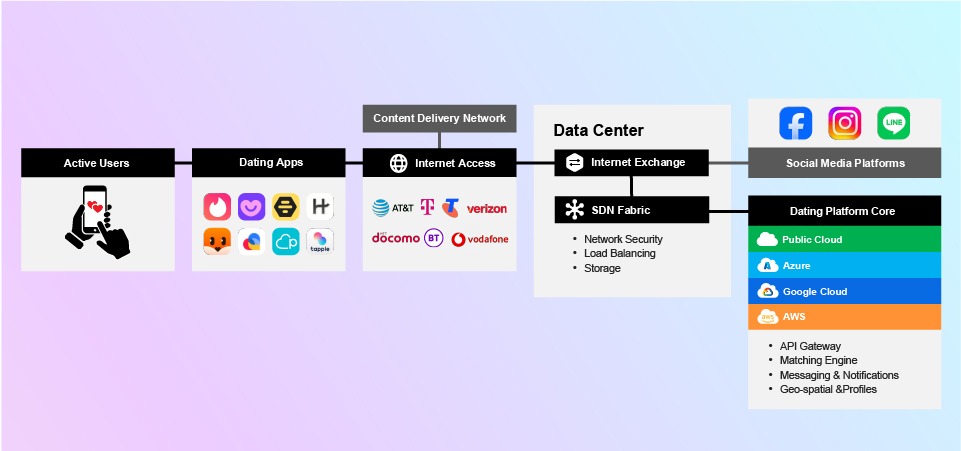
Where the dating ecosystem comes together
There’s no question that dating apps will use services from clouds and other ecosystem partners. The interesting part is where and how they’ll access those services.
A global, neutral co-location provider like Equinix can help them access the cloud services they need, when and where they need them.
Samuel Liu is Principal Product Manager of Equinix