

Imagine seeing different colours every time you hear someone say a word. What exactly is this intriguing condition known as chromaesthesia?
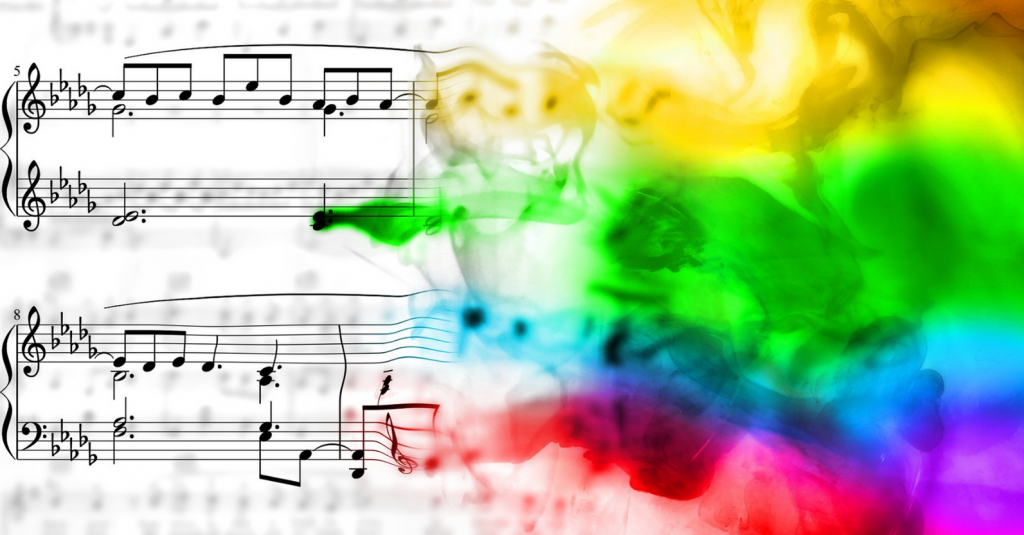
Chromaesthesia or sound-to-colour synaesthesia is caused by a sensory condition called synaesthesia in which sound involuntarily evokes an experience of colour, shape, and movement. The word synaesthesia comes from the Greek word synth (meaning “together”) and aisthēsis (meaning “sensation”).
There are two primary forms of chromaesthesia. One of these is called colour-hearing, which is the involuntary perception of colours by someone hearing sounds or listening to music. Another form is referred to as ‘audition colorae’ – the phenomena of hearing colours in music and vowels.
These reactions that occur in both these forms are brought on by stimuli. Instead of only hearing something, a person with chromaesthesia will also see it. Therefore, chromaesthesia simply means that when a person hears a note or a song for example, he or she tends to either see a specific colour for each specific note or get a sense of a general colour for each piece of music they hear. The colour associated with a sound may be determined by pitch, timbre and volume and it varies from person to person. For instance, a blow on a whistle may be grass-green for one but another person may see it in lavender, or even in crimson red.
Chromaesthesia is a relatively common condition, occurring in as many as one in 23 people, with more than 60 different forms documented. Famous musicians Pharrell Williams, Mary J. Blige, Tori Amos, Billy Joel and Lady Gaga all claim to have it. Authors and artists including Nabokov and Van Gogh are also said to have experienced different forms of synaesthesia.
Causes of Synaesthesia
According to a research by PLOS Biology, synaesthesia is when an individual’s all five senses stimulate a different area of the brain. For a person with synaesthesia, looking at a bright neon yellow wall, for example, will light up the primary visual cortex, at the rear of the brain. This person may also feel like they can taste the colour of the wall while looking at it. In this situation, not only are the primary visual cortex stimulated by the colour, but also the parietal lobe, which tells you what something tastes like, is stimulated, too.
Synaesthesia is not a disease. Researchers believe that people who have synaesthesia have a high level of interconnectedness between the parts of the brain that are tied to sensory stimulus. Speaking with a mental health professional may help a person to see the value synaesthesia can add to their life.
When does it Begin?
Synaesthesia is established during early childhood, when the brain is most malleable. There is a genetic predisposition for this condition, but the specific type is determined by environment and learning. Synaesthesia can be passed down through generations and it runs in families, but manifesting itself in a variety of ways.
A Creative Side
Individuals with chromaesthesia are drawn to play musical instruments and be artistically inclined. Ultimately, both the hobbies and occupations of synaesthetes are skewed toward the creative industries. It is estimated that one in eight synaesthetes are involved in the arts, with many of them often achieving great success. Individuals with synaesthesia are also more metaphorical because the same genes help them to relate concepts and ideas and, thus, being more creative.
Chromaesthesia manifests differently among individuals. It is entirely personal. Even though a person with this condition will always see the same colours according to specific sounds, these colours differ from one person to another.