

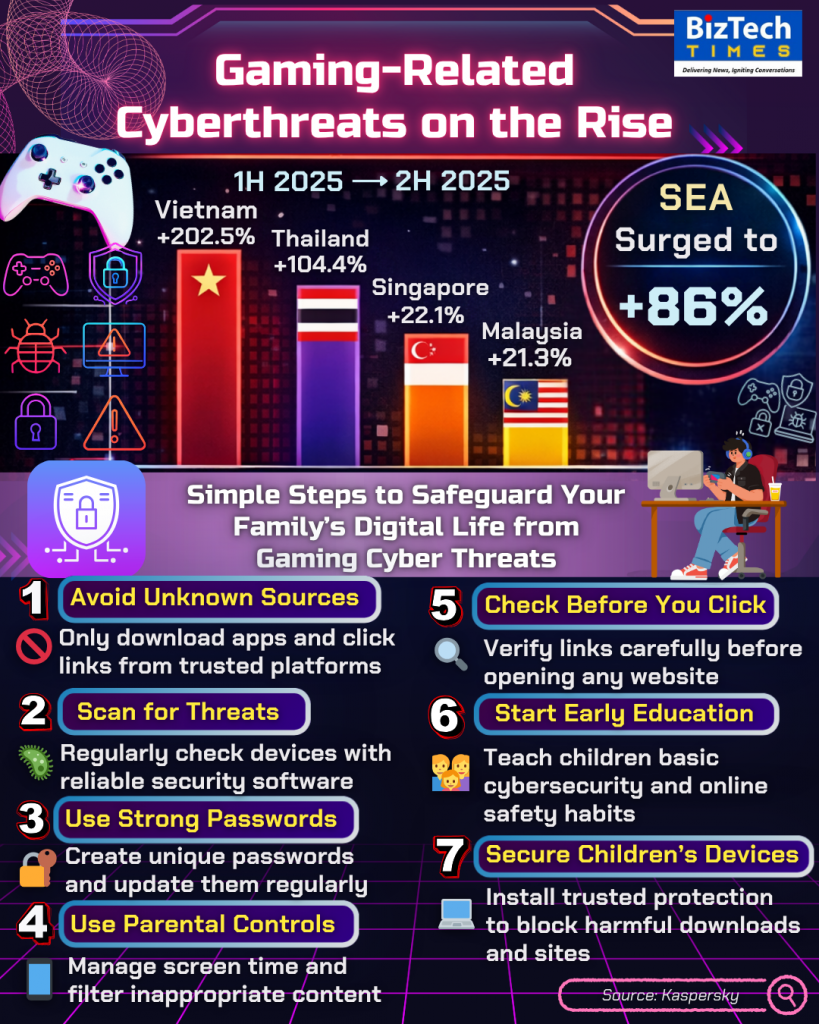
According to the latest data from global cybersecurity and digital privacy company Kaspersky, Southeast Asia (SEA) recorded a sharp 86% increase in the number of gaming-related cyberthreats detected on user devices from the first half of 2025 (1H 2025) to the second half of 2025 (2H 2025). Popular titles such as Roblox, Minecraft and Genshin Impact were among the most frequently exploited, used to lure unsuspecting players. Malaysia mirrored this regional trend, reporting a 21% rise in such threats.
Kaspersky’s findings indicate a steep rise in gaming-related cyberthreats targeted at young gamers, where malicious actors mimic popular games or create fake game-related tools to lure children into engaging with fraudulent webpages or downloading compromised files.
Across the region, the volume of these threats climbed 86% in 2H 2025, with Vietnam and Thailand experiencing the sharpest rises at 202.5% and 104.4%, respectively. Singapore (22.1%) and Malaysia (21.3%) also recorded significant increases. While Indonesia has bucked the trend, experts warn that the prevalence of gaming-related cyberthreats in the country is far from diminished and continues to pose an unignorable risk.
Among these gaming-related cyberthreats, some of the most targeted titles include Minecraft and Roblox, as the highly customisable nature of these games presents as ideal attack vectors for cybercriminals to exploit. Take for example Minecraft – players often download cheats and mods to personalise their gaming experience. However, cybercriminals take advantage of this behaviour to plant malware and PUAs (potential unwanted applications) disguised as these seemingly legitimate enhancements. Similarly, for Roblox, threat actors capitalise on players’ desire for new or rare character skins to deploy fraudulent websites that seemingly promise access to these exclusive in-game items. In reality, these are scams that can leave victims empty-handed, or worse, result in the theft of personal and financial credentials that leaves them vulnerable to further cyberattacks.
Rippling consequences – implications extend beyond the targeted victim
The implications of these cyberattacks extend far beyond the targeted individual, often capable of resulting in rippling consequences for the household. This is because young gamers who fall victim to these malicious campaigns may unknowingly offer sensitive details such as their parents’ credit card information or even their household address. Such details can be used for financial theft, as well as to facilitate other illicit activities, including the crafting of social engineering cyberattacks on the family. Additionally, any malware and PUAs (potential unwanted applications) they inadvertently download on shared family devices may also compromise the privacy and data of all users on that device.
“We continue to observe a heightening intensity of gaming-related cyberthreats targeted at young children, as cybercriminals attempt to exploit their high levels of digital connectivity and their excitement around popular games and personalised experiences to launch their malicious campaigns. What is especially concerning is that these threats endanger not only the cyber safety of our young gamers, but also that of their households, as they act as entry points to the wider family network. It is therefore crucial for families to recognise the importance of protecting every family member’s digital interaction in order to truly ensure the household’s digital safety,” comments Choon Hong Chee, Head of Consumer Channel for APAC at Kaspersky.