


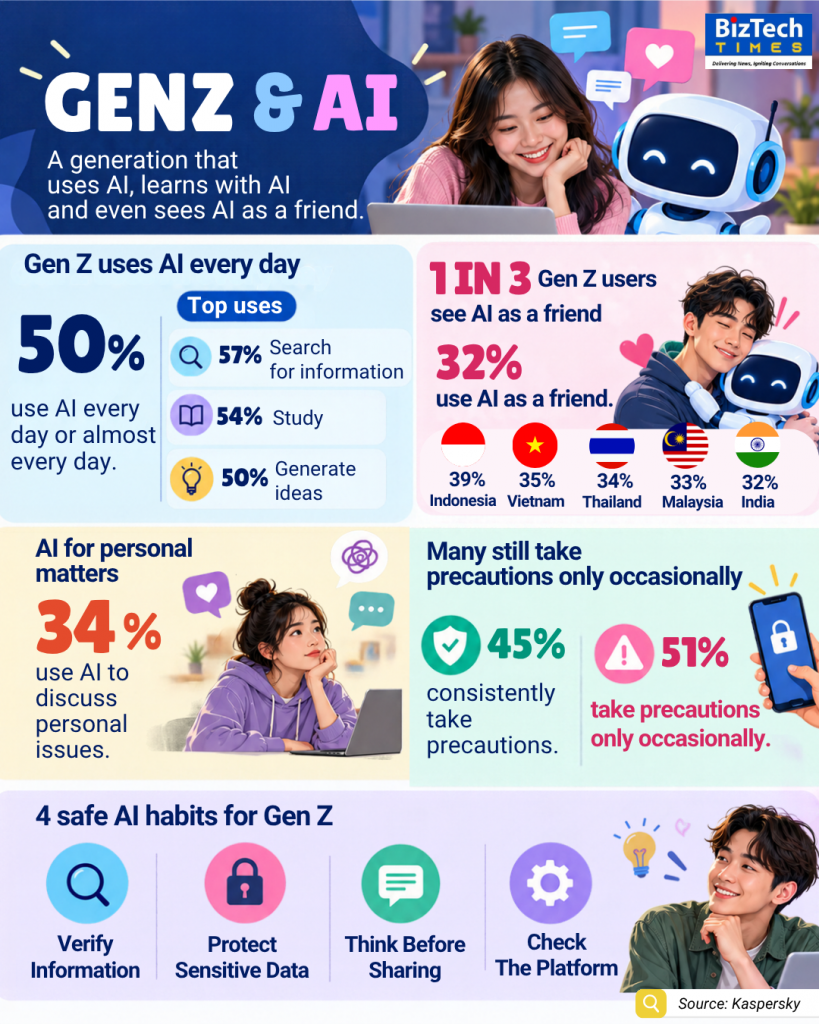
Based on Kaspersky’s latest research, nearly a third of APAC Gen Z respondents (32%) say they use AI as a friend – a higher proportion than among other generations. This behaviour is consistent across the Asia Pacific region, from Indonesia (39%), Vietnam (35%), Thailand (34%), Malaysia (33%) to India (32%).
The survey results point to an emerging shift in the role of artificial intelligence, from a technology consulted for specific tasks to one that some users may also turn to for conversation, emotional support or companionship. Half of Gen Z respondents (50%) in APAC use AI every day or almost every day – the highest share across all the demographic groups. Among them, 57% use it for searching for information, 54% for studying, and 50% for generating ideas.
The use of AI for personal matters reflects how naturally conversational systems fit into Gen Z’s digital habits. According to the survey, 34% of Gen Z respondents in the region use AI to discuss personal issues they would rather not share with other people. Vietnam recorded the highest percentage at 42%, followed by India (37%) and Indonesia (36%). This may make AI feel private and emotionally supportive, but it is not a human friend: its responses can be inaccurate or inappropriate, and users may disclose sensitive information more freely than they would on an ordinary online service.
For many Zoomers, AI has already become part of their daily routine.
High reliance does not always mean safe AI use
Despite Gen Z’s high level of online activity and confidence, many respondents underestimate the risks associated with artificial intelligence. While 45% of Gen Z respondents in APAC say they consistently take protective measures when interacting with AI services, more than half (51%) only apply precautions occasionally. This inconsistency is particularly evident in Malaysia, where 54% of respondents say they take precautions only occasionally, the second-highest proportion among the APAC markets surveyed after China (60%), while Indonesia recorded the lowest proportion at 43%.
These protective measures can be as simple as checking information against other reliable sources and avoiding the disclosure of confidential or sensitive data. This is particularly important as AI becomes involved in education, communication and personal decision-making.
Incorrect information generated by an AI system may affect academic work or everyday choices, while information shared in a conversation may include personal documents, passwords, financial details, health-related information or private messages. The more personal the interaction becomes, the more important it is for users to remember that information entered into an AI service should automatically be treated as non-confidential.
Safe AI habits should develop alongside AI skills
To use AI more safely, people should verify important information rather than rely on a single generated response. This is especially important for educational, financial, legal, medical or other sensitive topics where an inaccurate answer may have serious consequences.
Users should also avoid sharing passwords, payment details, identity documents, private correspondence and other confidential information with AI services. Before using a new platform, it is important to understand what data it collects and how that information may be processed or stored.
“Gen Z understands emerging AI trends better than other generations and is already finding new ways to integrate the technology into studying, communication and everyday life. The fact that some young people now use AI as a friend shows how quickly the relationship between users and technology is changing,” said Vladislav Tushkanov, Group Manager at Kaspersky AI Technology Research Centre. “However, an interaction that feels personal should not be mistaken for a private or fully reliable conversation. Young users need to combine their confidence and curiosity with habits such as checking information, protecting personal data and thinking critically about the responses they receive.”
“What stands out about the survey is how naturally AI has become part of the younger generation’s everyday lives. When one in three Gen Z users in APAC already sees AI as a friend, it is clearly becoming more than just a tool. As that relationship becomes more personal, knowing what to trust, what to share and where to draw the line will be key to using AI safely and responsibly,” concluded Adrian Hia, Managing Director for Asia Pacific at Kaspersky.