


For many victims, a scam does not always begin with fear. Job scams are met with a sense of hope especially those searching for financial stability or extra earnings. In today’s economy, where rising living costs continue to pressure households, the promise of easy money can be difficult to ignore. However, behind many of these attractive offers, scammers are working quietly to exploit human emotions and vulnerability. Victims may be told that limited positions are available or that they must act quickly to secure the job. This pressure reduces the likelihood that victims will pause to verify the legitimacy of the offer.
Job and employment scams have become one of the fastest-growing forms of fraud affecting Malaysians in recent years. Data released by the Royal Malaysia Police (PDRM) showed more than 8,900 job scam cases recorded in 2025, with WhatsApp accounting for approximately 43 percent of reported scam channels. According to the Bukit Aman Commercial Crime Investigation Department (CCID), 1,537 job scam cases were recorded between January and March 2026, resulting in losses exceeding RM31.8 million. These figures highlight not only the scale of the problem but also how scammers are adapting to changing economic and technological trends.
Some scammers intentionally pay victims small amounts of money during the early stages to build trust. A victim who receives money after completing a few simple tasks may become convinced that the opportunity is legitimate. Once trust has been established, the scam enters its next phase. Victims are informed that they can earn larger commissions by upgrading their accounts, purchasing packages, or depositing money into certain platforms. Some are told they must complete “double tasks” to unlock higher earnings. Others are pressured into transferring funds to continue participating in the programme.
One reason job scams remain effective is because they exploit emotions rather than technical weaknesses. Victims are not hacked in the traditional sense. Instead, they are manipulated psychologically.
Another factor contributing to the rise of job scams is the increasing sophistication of digital fraud tools. Artificial intelligence, automated messaging systems, and fake online reviews now allow scammers to create highly convincing operations at relatively low cost. Fraudulent websites can appear professional, complete with customer testimonials, live chat functions, and polished branding.
Recognise Red Flags
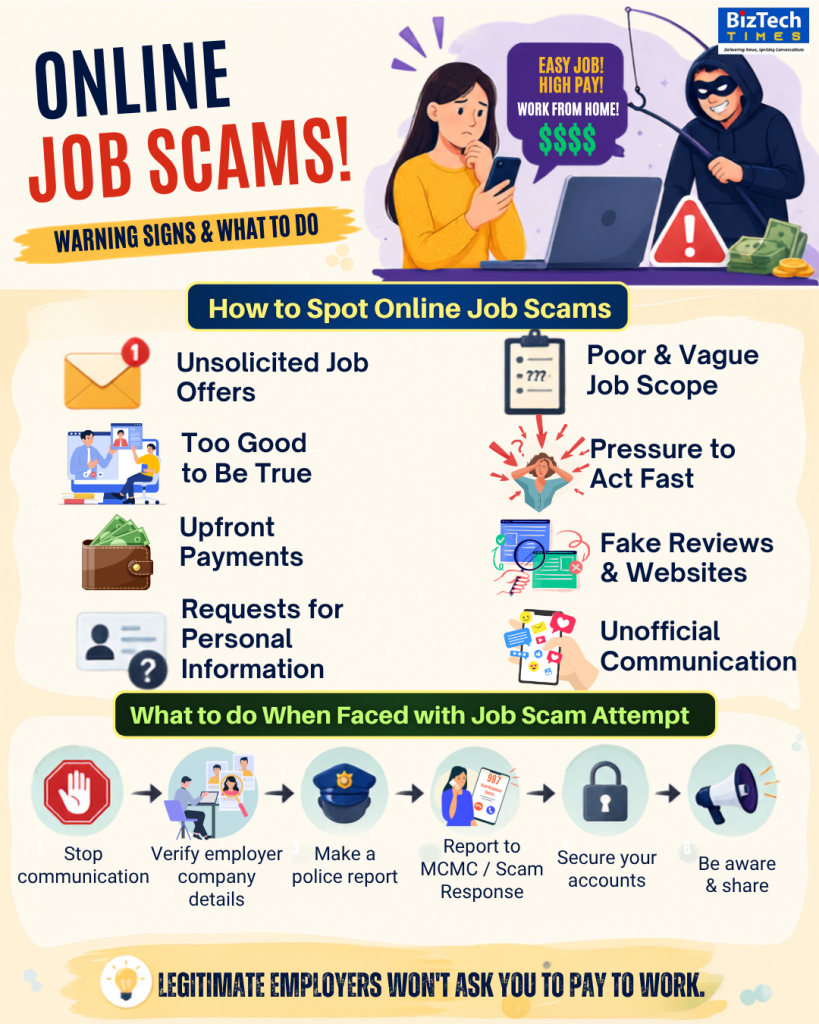
Although online job scams come in many forms, most share several common warning signs. Recognising these red flags early can help job seekers avoid financial losses and identity theft.
One of the most obvious warning signs is an unsolicited job offer. The message often claims that the recipient has been specially selected for a lucrative opportunity with minimal qualifications required.
Legitimate employers generally offer compensation that reflects the skills, experience, and responsibilities required for a role. Offers that guarantee substantial income for activities such as liking social media posts, watching videos, completing surveys, or clicking links should be approached with caution. Requests for upfront payments are another strong indicator of fraud. Any job offer that requires financial transfers whether it is to purchase work packages or access training materials before work begins should immediately raise suspicion.
Poorly written job advertisements, vague job descriptions, and a lack of information about the employer can also signal fraudulent activity. In many cases, scammers provide limited details about the role while focusing heavily on potential earnings.
Finally, job seekers should exercise caution when recruiters request sensitive personal information such as banking details, identity card copies, passwords, or one-time verification codes during the early stages of recruitment. Such information can be used for identity theft or financial fraud.
Be Vigilant, Yet Skeptical
Protecting against online job scams requires a combination of vigilance, verification, and healthy scepticism. Before accepting any job offer, individuals should conduct independent research on the company. This includes checking official websites, verifying business registration details, reviewing social media presence, and searching for online reviews from current or former employees.
Keeping phone and app software updated helps block scam calls and messages, especially from unknown or foreign numbers. Many devices also offer settings to send unknown calls directly to voicemail and provide spam warnings for suspicious contacts. In addition, privacy settings on messaging apps like WhatsApp and Telegram can be adjusted to block and report suspicious accounts, helping to reduce unwanted contact and prevent further scam activity.
Based on CyberSecurity Malaysia’s MyCERT advisory, job seekers are advised to verify company registration details, search for independent online reviews, and confirm whether the organisation has a legitimate digital presence before accepting offers or sharing personal information. Contacting companies directly through official websites or verified phone numbers can also help confirm whether recruitment advertisements are genuine.
As online recruitment and remote work opportunities continue expanding, job scams are expected to remain a persistent threat in Malaysia and across the region. Digital platforms have undoubtedly created genuine economic opportunities, but they have also opened new spaces for scammers to exploit trust, ambition, and financial uncertainty.
The challenge moving forward will not only involve stronger enforcement and platform regulation but also improving digital literacy and public awareness. In an increasingly connected economy, the ability to recognise manipulation and verify information has become just as important as finding opportunity itself.
By BizTech Times editorial team