

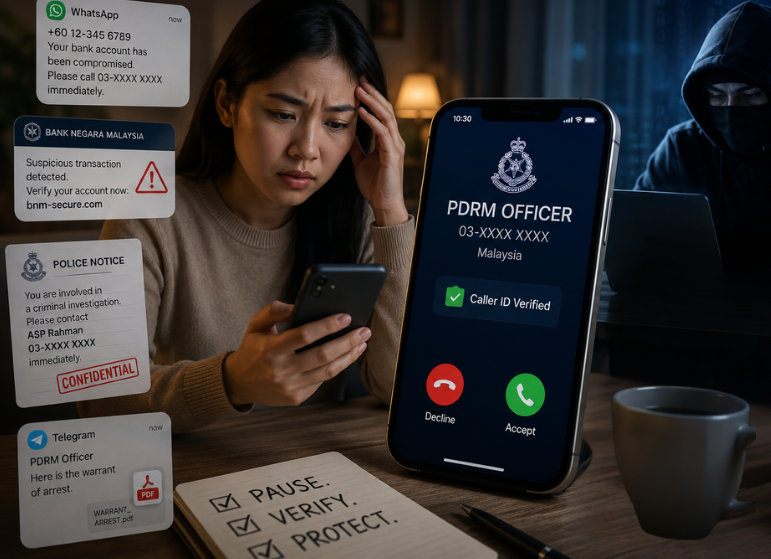
Impersonation scams remain one of the most common forms of fraud affecting Malaysians today. A phone call claiming to be from the police, a bank officer, or a government agency may last only a few minutes, but for many victims, the consequences can be devastating and long-lasting. What begins as a seemingly ordinary conversation can quickly spiral into panic, confusion, and financial loss. The scammer’s objective is to create fear and urgency so that victims will react emotionally before they have time to think critically about the situation, scammers manipulate victims psychologically into transferring money, revealing sensitive banking information, or granting access to personal devices.
A victim may receive a call informing them that suspicious transactions have been detected in their bank account, or that a parcel linked to illegal activity has been intercepted, or that they are involved in a criminal investigation. The scammer usually uses lengthy “interrogation” tactics mimicking a real investigation to establish a sense of legitimacy.
The complexity of scams often trick victims easily into believing them. Some perpetrators may even create background office noises, ‘validate’ their identities by sending out fake documents through messaging applications, or circumvent caller ID system by displaying legitimate-looking phone numbers. Some scammers even use official logos, and fake websites to strengthen the illusion that communication is genuine.
Advanced Scammer Tactics
One of the most dangerous developments in recent years has been the growing use of caller ID spoofing technology. This allows scammers to manipulate phone numbers so incoming calls appear to originate from legitimate organisations such as banks or government agencies. For many victims, seeing a familiar or official-looking number on their phone creates an immediate sense of trust.
At the same time, scammers are becoming increasingly sophisticated in their use of technology. Artificial intelligence-generated voices, phishing websites, and fake mobile applications are making impersonation scams harder to detect. Some victims are instructed to download applications that supposedly help secure their accounts but actually allow scammers remote access to their devices and banking information.
Malaysian cybersecurity experts have warned that modern scams rely heavily on social engineering rather than technical hacking alone. In many cases, victims are psychologically pressured into cooperating willingly because they believe they are protecting themselves from legal or financial danger.
Although older adults are often viewed as primary targets, impersonation scams increasingly affect younger and digitally savvy individuals as well. As Malaysians become more dependent on online banking, e-wallets, and digital communication platforms, scammers are adapting their tactics to exploit these habits. Younger users who are comfortable conducting financial transactions online may sometimes react quickly to urgent digital requests without fully verifying their authenticity.
The widespread use of messaging applications such as WhatsApp and Telegram has also created new opportunities for scammers. Fraudsters can now send fake notices, forged documents, or phishing links instantly to large numbers of people. Social media platforms have further expanded the reach of impersonation scams, allowing scammers to gather personal information that can later be used to make scam attempts appear more convincing.
Financial losses linked to impersonation scams continue to be significant across Malaysia and the wider ASEAN region. According to Royal Malaysia Police (PDRM) Commercial Crime Investigation Department (CCID), Malaysia recorded 67,735 online crime cases between January and November 2025, with losses exceeding RM2.7 billion. Telecommunications-related scams, which accounted for 28,698 cases and losses of more than RM715 million.
The threat extends beyond Malaysia. According to the GSMA’s ASEAN Consumer Scam Report 2025, the proportion of ASEAN consumers who reported having been scammed increased from 31% to 43%, while 68% of scam victims said they suffered financial losses. The report also found that scams increasingly originate through everyday communication channels such as messaging applications, voice calls, and social media platforms, highlighting how impersonation tactics continue to evolve alongside digital communication habits.
How to Spot an Impersonator
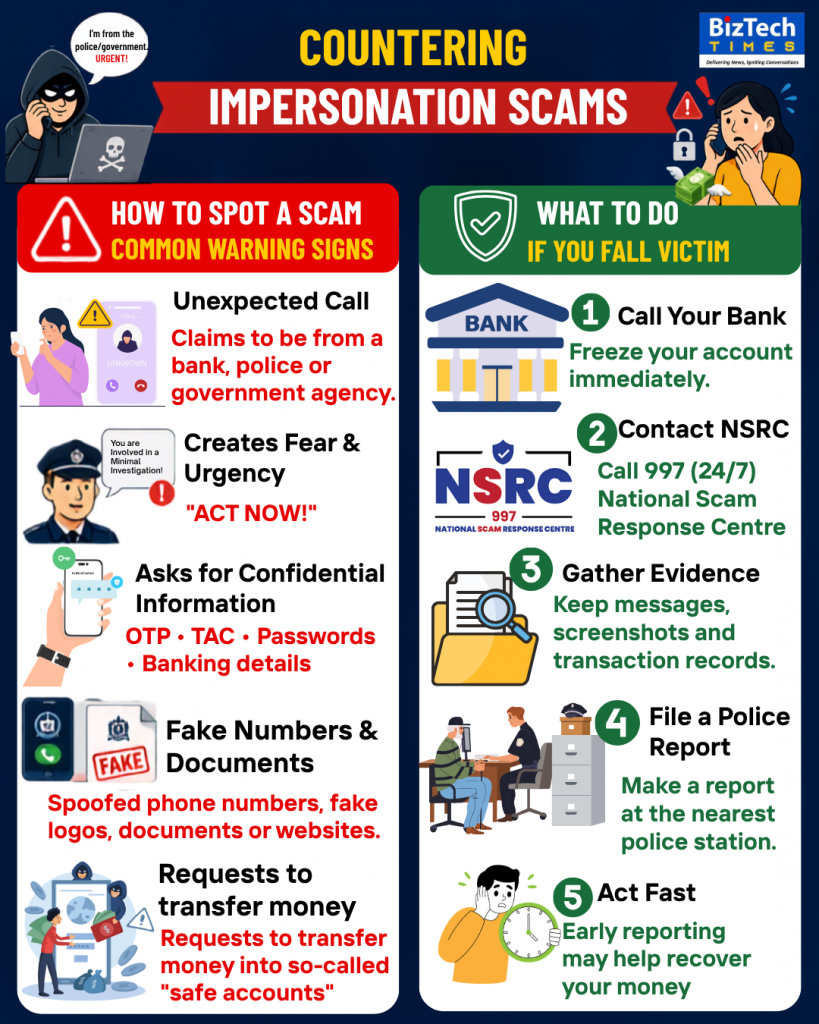
While impersonation scams continue to evolve, consumers should be aware of common warning signs and learn how to recognise them. One of the most common indicators is an unexpected call, message, or email claiming that urgent action is required. Scammers frequently create a sense of panic by alleging that a bank account has been compromised, a parcel has been linked to criminal activity, unpaid taxes are due, or a police investigation is underway.
Another warning sign is pressure to act immediately. Genuine banks, government agencies, and law enforcement authorities generally provide official channels for verification and do not demand instant decisions during unsolicited calls.
Consumers should also be cautious of requests for confidential information such as banking passwords, TAC codes, OTPs, credit card details, or internet banking credentials. Bank Negara Malaysia and Malaysian banks consistently remind customers that such information should never be disclosed to third parties.
Requests to transfer money into so-called “safe accounts” are another major red flag. According to the National Scam Response Centre (NSRC) and Bank Negara Malaysia, legitimate authorities and financial institutions do not instruct individuals to move funds into temporary accounts for security purposes.
Knowing how to respond can significantly reduce the risk of becoming a victim. The safest approach is to end the conversation and independently contact the organisation using official telephone numbers published on its website.
Act Immediately to Recover Loss
If money has already been transferred or sensitive information disclosed, victims should immediately contact their bank and report the incident to the National Scam Response Centre (NSRC) via the 997 hotline. Early reporting increases the likelihood that suspicious transactions can be traced or frozen before funds are moved through multiple accounts.
As technology continues to evolve, impersonation scams are likely to become even more sophisticated. However, the core strategy behind these scams remains largely unchanged: exploiting trust, fear, and urgency to manipulate victims into making rushed decisions. Sometimes, taking a few extra moments to pause, verify, and question a suspicious call can make the difference between staying safe and suffering serious financial loss.
By BizTech Times editorial team