

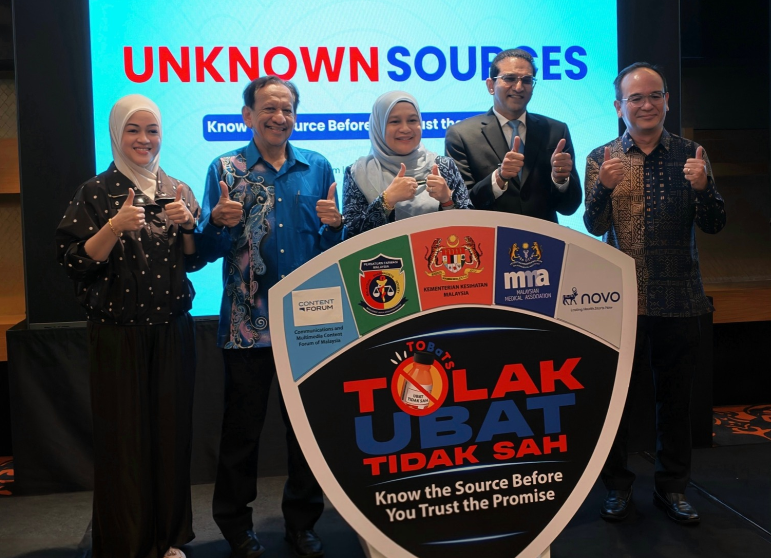
Malaysians are urged to look beyond the simple question of whether a medicine is “fake” or “genuine” but whether the medicine itself is appropriate after proper assessment by a medical professional. The clarion call was jointly made by the Ministry of Health Malaysia, Pharmacy Enforcement Division, Malaysian Medical Association, Malaysian Pharmacists Society Multimedia Content Forum of Malaysia during a recent forum UNKNOWN SOURCES: Know the Source Before You Trust the Promise.
Supported by Novo Nordisk Malaysia in conjunction with Ministry of Health’s Tolak Ubat Tidak Sah (TOBaTS) public-awareness initiative, the forum aims to support and amplify the existing government-led platform through practical public education on medicine verification, legitimate access and responsible decision-making. The Pharmacy Enforcement Division (BPF), Ministry of Health Malaysia received 101 complaints and conducted 47 raids involving weight-loss products, including 30 linked to online sales, with seizures valued at RM771,517 between January and September 2026, showing growing concerns over how medicines and health products are reaching consumers through digital and unfamiliar channels.
As public interest in medicines used for chronic conditions, including diabetes and weight management, continues to grow, greater awareness and willingness to seek support can be positive. However, increased demand can also create opportunities for misleading claims, inappropriate access and unknown supply routes that bypass established safeguards. A medicine obtained from an unknown source can raise several different concerns: it may be unregistered, supplied illegally, advertised inappropriately, stored under uncertain conditions, or obtained without the clinical assessment and professional oversight required for its safe use.
Dr Azuana binti Ramli, Deputy Director-General of Health (Pharmaceutical Services), Ministry of Health Malaysia said, “Patient safety begins long before a medicine is taken. As access to medicines becomes increasingly digital, consumers must be empowered to verify medicine registration, purchase from legitimate sources, seek professional advice when needed, and report suspicious products or activities.”
The Ministry has also introduced the use of holographic security labels on all registered pharmaceutical products as a measure to help consumers identify legitimate products. The authenticity of these labels can be verified through the MyUBAT smartphone application.
Protecting Public Health Through Effective Enforcement
Tn Mohd Zawawi Abdullah, Director of Pharmacy Enforcement, MOH said, “Medicines obtained from unknown or unauthorised sources pose serious risks to public health. Public vigilance and reporting are essential in helping authorities detect suspicious products and illegal activities. BPF takes proactive enforcement measures, including continuous monitoring, blocking and takedown of illegal online advertisements, seizures as well as investigations and prosecution of sellers who violate the law. Close collaboration with other enforcement agencies, pharmaceutical industries, e-commerce platforms, influencers and other relevant stakeholders is essential to strengthen information sharing, coordinate enforcement actions and combat the illegal sale of medicines, particularly through online platforms.
Why a genuine-looking medicine is not the whole safety question
“The question is not only whether a medicine appears genuine. We also need to ask whether it is appropriate for that person, whether they have been properly assessed and who is monitoring their treatment’, said Dr Sivanaesan Letchumanan, President of the Malaysian Medical Association during the forum.
“A consultation gives doctors the opportunity to understand a person’s medical history, existing conditions, other medicines and potential risks before treatment begins. It also provides follow-up if there are side effects, concerns or a need to review treatment. Those safeguards cannot be replaced by an online listing, a testimonial or advice from an anonymous seller,” added Dr Sivanaesan Letchumanan.
Honorary Prof Amrahi Buang, President of the Malaysian Pharmacists Society explained that a licensed pharmacy is not simply a place where a medicine changes hands. It is an important safety checkpoint. “Consumers may not be able to determine from a photograph or online listing how a medicine has been transported or stored. Pharmacists can help people understand registration and prescription requirements, correct use and storage considerations, while providing a professional point of accountability when something is unclear,” added Prof Amrahi.
Supporting the existing TOBaTS platform
“People are encountering more health information, more claims and more offers than ever before. That can be positive when it encourages people to understand their health and seek appropriate support, but it also makes trusted information and legitimate pathways increasingly important. TOBaTS is the Ministry of Health’s established public-awareness platform. Novo is supporting that work by helping extend the conversation around responsible medicine access and bringing different stakeholders together around one simple principle: know the source before you trust the promise.” said Tee Loong Tek, Head of Market Access and Public Affairs, Novo Malaysia.