

In an exclusive two-part interview series, BizTech Times speaks to Datuk Dr. Tan Tat Wai, Honorary Treasurer of Rubber Trade Association of Penang (RTAP) on its role in Malaysia’s economic development and how the industry evolve to what it is today.
Kindly click here to read the next article
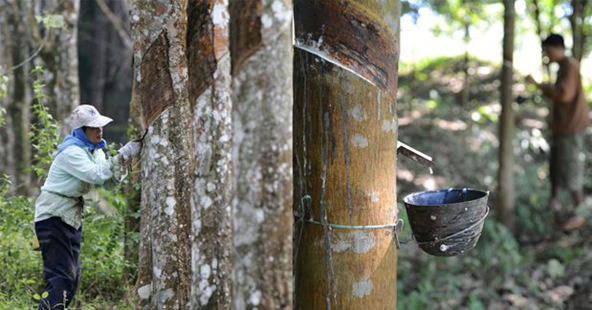
Natural rubber was a key commodity export for Malaysia several decades ago. However, due to various push and pull factors and issues within the rubber industry, rubber cultivation has been rendered rather uncompetitive today.
This situation was further exacerbated by the federal and state government’s decision to switch from rubber to oil palm cultivation because of higher returns and less labour intensive nature of oil palm cultivation.
“Even if state governments are willing to delineate and open more forest land for rubber planting today, Malaysia still faces labour shortage constraints,” said Datuk Dr Tan Tat Wai, Rubber Trade Association Penang’s (RTAP) honorary treasurer.
“Despite the greater focus placed on rubber gloves and other rubber-related products, it is not likely that rubber, as a crop, will make a comeback as a key commodity. It may be possible, but unlikely.”
Today’s young generation also prefers the bright lights of urban life instead of life as a farm hand, he said.
“Almost all rubber traders and millers have retired or pulled out from the rubber trade. We are now left with less than a handful or large Standard Malaysian Rubber (SMR) producers in northern Malaysia, two of which are owned by major Thai and Chinese conglomerates,” he said.
He explained that RTAP has never played the role of nurturing start-ups, but to manage and co-ordinate planters, dealers, importers and individuals in the upstream industry.
Rubber product manufacturers are associated with, and are serviced by the existing Malaysian Rubber Products Manufacturers Association (MRPMA), he added.
RTAP Sets Up Rubber Exchange
The Rubber Trade Association of Penang (RTAP) is one of the oldest surviving rubber trade associations in Malaysia. It was founded in 1919 as a rubber exchange to provide daily pricing and settlement mechanism. This was a critical function in the development of the rubber trade in British Malaya. RTAP was officially established in 1947.
Prior to its establishment, traders in north Malaya were late in receiving information on international rubber pricing and depended on British buyers in Georgetown to buy and pay for rubber. RTAP facilitated the transmission of accurate and timely pricing information to its members, thus enabling a more robust and fair trade. The association also played a major role supervising and co-ordinating trade settlement, including resolving disputes to ensure a smoother trade process. However, this exchange function ended in 1962 when the government established the Malaya Rubber Exchange (MRE), with RTAP being a founding member.
The MRE was the sole regulatory and supervisory body set up to promote, develop, market and distribute rubber in Malaysia. On Jan 1, 1998, MRE was replaced by the Malaysian Rubber Board (MRB).
MRB’s primary objective was to assist in the development and modernization of the industry from cultivation, extraction and processing of raw rubber. It was also involved in the downstream manufacture and marketing of rubber products.
Rising Rubber Production
Ironically, in spite of global rising rubber production and increasing demand, Malaysia’s natural rubber production has been in steady decline since the switch to oil palm cultivation.
The diminished role of natural rubber sectors was reflected in RTAP’s activities and membership. As of 2021, the association has only 30 members, having shrunk from a peak of several hundred during the 1950s and early 1960s. This situation was similar across other rubber trade associations in Malaysia.
Malaysia’s limited latex concentrate production is unable to feed the robust rubber gloves, condom and other downstream latex products makers today.
Natural Rubber Production (tons) and Rubber Product Export (RM million) in 2019
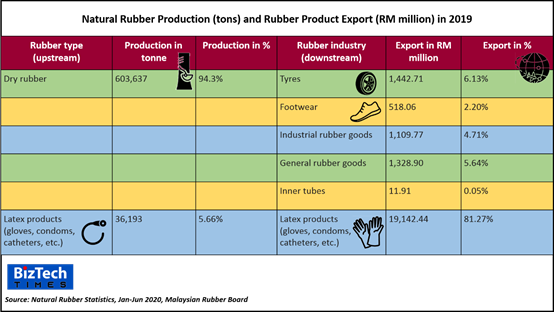
“Our glove makers have moved beyond natural latex gloves into nitrile (synthetic rubber) gloves. Thus, our own natural rubber latex is supplying 8% of the needs of glove makers with the rest either imported Thai latex or locally produced nitrile latex,” said Datuk Dr Tan.
Malaysia’s Latex Production, Import, Export and Consumption in 2019 and Jan-Sep 2020
| Year | Latex | Latex | Latex | Latex |
| Production | Import | Export | Consumption | |
| 2019 | 36,193 | 312,006 | 23,188 | 451,587 |
| January – September 2020 | 22,590 | 257,617 | 14,182 | 339,694 |
The above table shows Malaysia imports more rubber latex than produces it. This is because smallholders have their preferred mode of rubber production, which is collecting cup lump over latex.
Cup lump is the coagulated material found in the collection cup which is tied or hooked on the trunk of a rubber tree. The cup lump is formed when latex clings to the walls of the cup after its previous collection. Rubber trees are unique. Vessels carrying latex run alongside the tree trunk. Once the bark of the tree is cut, latex oozes from the vessels and drips into a cup.
It will continue to drip latex until the vessels become naturally blocked. Collecting the cup lump is less labour-intensive than latex collection because latex has to be collected the day it is tapped.
“Collecting latex requires more work. Tappers need to complete two rounds of tapping and collecting of latex; once in the wee hours in the morning, and another round before noon. Collecting cup lumps require only two to three hours of work anytime on another day. So the lack of labour also contributes to the low production rate,” explained Datuk Dr Tan.