


In mid-December 2025, just weeks before Malaysia’s groundbreaking carbon tax came into force, TotalEnergies and Google finalised a 21-year agreement to supply 1 TWh of renewable power from the Citra Energies solar farm in Kedah. Construction is scheduled to begin in early 2026, with the facility powering Google’s $2 billion data centre in Selangor’s Elmina Business Park.
The timing reveals more than corporate sustainability messaging – it’s a calculated bet on Malaysia’s emergence as the region’s solar leader, made at the precise moment when the economic calculus of energy transitions fundamentally shifts. As 2026 begins, that shift has arrived. Malaysia’s carbon tax targeting steel, cement, and energy sectors is now in effect, and the country’s new Solar ATAP programme (Solar Accelerated Transition Action Programme) launched on 1 January 2026 for businesses from retail chains to data centres, the message is unambiguous: energy strategy is no longer optional boardroom discussion, but a cost, competitiveness and compliance issue.

When Google broke ground on its Malaysian data centre in October 2025, the tech giant wasn’t just expanding cloud capacity. The investment is expected to generate $3.2 billion in economic impact and create 26,500 jobs by 2030, but more crucially, it positions Google ahead of Southeast Asia’s carbon pricing wave. Malaysia’s appeal extends beyond cost efficiency. The nation successfully leveraged its 2025 ASEAN Chairmanship to guide the bloc through over 320 meetings, achieving more than 80 key outcomes while championing “Inclusivity and Sustainability.” October’s launch of the ASEAN Plan of Action for Energy Cooperation (APAEC) 2026–2030 established Malaysia not just as a diplomatic convener, but as the region’s clean energy standard-bearer.
The government’s policy arsenal gives businesses concrete reasons to move fast. Large Scale Solar 6 (LSS6) will introduce 2 GW of additional solar capacity, generating approximately RM 6 billion in private investment opportunities. The Green Technology Financing Scheme offers RM 1 billion in government-backed guarantees until December 2026, while the Corporate Renewable Energy Supply Scheme (CRESS), launched in September 2024, enables unprecedented third-party grid access for renewable trading.
The energy transition is no longer confined to hyper-scalers and multinational corporations. Malaysian businesses operating in traditionally energy-intensive sectors are also moving decisively. Take Billion Group of Companies, a Malaysian retail chain established in 1985, which began its solar journey in 2023 – well ahead of the regulatory crunch. Following a phased deployment across five locations, EFS Group partnered with the retail group to deploy rooftop solar PV systems totaling up to 3 MWp. Once fully operational, the portfolio is expected to generate approximately 4,500 MWh of clean energy annually, offsetting 3,300 tonnes of carbon dioxide – equivalent to powering 900 Malaysian households.
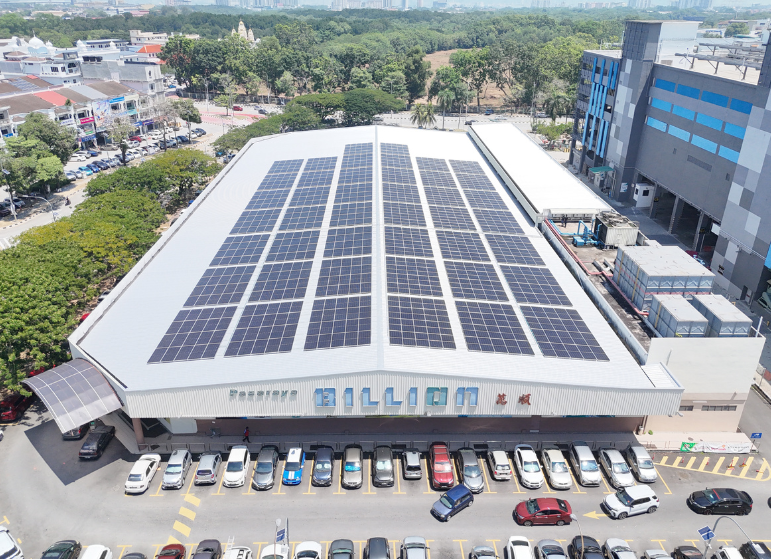
Billion’s transition is an emblematic of a broader shift. The retail sector is slowly understanding that solar power doesn’t just protect their margins – it future-proofs their energy strategies. With government-backed incentives and schemes, businesses reduce their carbon footprint by decreasing dependence on fossil fuels. And crucially, solar energy doesn’t rely on traditional infrastructure, making it suitable even for remote locations. For retailers operating on thin margins with predictable, high-energy consumption, solar represents more than environmental virtue – it’s an operational necessity. As Malaysia’s carbon tax is now a reality, the question has shifted from “why go solar” to “can we afford not to?”
Malaysia’s carbon tax, confirmed in Budget 2026, is now being implemented with initial focus on iron, steel, and energy sectors. The policy isn’t occurring in isolation. The European Union’s Carbon Border Adjustment Mechanism (CBAM) takes full effect in 2026, requiring importers to pay for embedded carbon in goods like steel, cement, and aluminium – sectors accounting for an estimated 75% of Malaysian exports to the EU.
Here’s the critical detail: CBAM allows deductions for carbon taxes already paid domestically. Without its own carbon pricing mechanism, Malaysian exporters would effectively pay carbon taxes to Brussels while receiving none of the domestic revenue or policy benefits.
While final tax rates have yet to be publicly confirmed, early projections place Malaysia’s carbon price within a range broadly aligned with international benchmarks. Together, domestic carbon taxation and CBAM are reshaping cost structures for export-oriented industries, making emissions management a commercial necessity rather than a reputational consideration.
Malaysia’s solar ambitions face real constraints. Over 6 GW of solar capacity has been approved across six LSS bidding rounds to date, but grid capacity must keep pace. The government’s record RM42.8 billion capital expenditure allocation for transmission and distribution upgrades under the fourth regulatory period (2025-2027) signals recognition that renewable ambitions mean nothing without grid infrastructure to support them.
Battery storage emerges as the next frontier – and not by choice. The government has confirmed that the next LSS bidding round will require Battery Energy Storage Systems (BESS) as mandatory grid-firming infrastructure, potentially adding RM 2 billion in additional EPCC opportunities. For businesses, this means solar-plus-storage solutions transition from optional to standard.
The technical reality driving this shift is stark. Analysis from climate think tank Ember indicates Malaysia’s grid can technically accommodate up to 30% solar penetration before solar costs escalate, but above 40% will require scheduled curtailment to maintain stability. As solar met approximately 8-11% of power demand at noon in early 2025, certain grid zones already experienced midday oversupply during peak generation hours. Without storage to absorb excess daytime generation, businesses with rooftop installations face declining export values precisely when their systems hit maximum productivity.
The updated 2025 SELCO Guidelines now mandate BESS for solar installations above 1 MWac, making battery integration a compliance requirement for commercial adopters and becoming the new industry baseline. From my perspective, BESS transforms solar from a passive energy offset into an active operational asset.
For hypermarkets and chains operating long hours with heavy refrigeration loads, storing excess midday generation for evening peak periods maximises self-consumption, stabilises energy costs, and reduces exposure to peak demand charges that can represent significant portions of commercial electricity bills.
The urgency intensifies when considering future demand patterns. Ember projects Malaysia’s data centre power consumption will reach 30% of total national demand by 2030 – driven largely by AI and cloud computing facilities that operate continuously. This surge in baseload and evening peak demand occurs precisely when solar generation drops to zero, creating a supply-demand mismatch that battery storage directly addresses.
As Malaysia enters 2026, several critical developments are converging in ways that will fundamentally reshape how Malaysian businesses approach energy strategy. In Q1 2026, Solar ATAP goes live, removing capacity caps for rooftop solar installations and enabling systems of up to 100% of maximum demand for non-domestic users. However, excess energy is settled within the same billing period and does not carry forward – placing greater emphasis on system optimisation and self-consumption. Also in Q1 2026, updated SELCO guidelines take effect, making BESS mandatory for larger commercial installations and embedding storage considerations into project design from the outset.
By Q2 2026, LSS6 bidding opens, introducing 2 GW of new utility-scale capacity alongside expected storage requirements, signalling that grid modernisation has moved firmly into execution. Throughout 2026–2027, carbon pricing expands, with initial sector coverage beginning to influence procurement, financing and export competitiveness, particularly for emissions-intensive industries. By 2027, large-scale corporate PPAs come online, transitioning long-term renewable procurement models transitioning from policy ambition to operating proof points.
Solar ATAP favours businesses willing to engage early with a more sophisticated energy landscape rather than waiting for simplified solutions later. Early adopters benefit from locking in today’s regulatory structures, securing favourable grid connection points, and leveraging available tax incentives before policy frameworks evolve. Just as importantly, early action allows organisations to integrate renewable energy into long-term operational planning, rather than retrofitting solutions under regulatory or cost pressure. In a market where grid capacity, experienced contractors and optimal system designs are finite resources, timing itself has become a strategic advantage.
With Solar ATAP active, storage requirements tightening, and carbon pricing entering operational reality, Malaysia’s solar transition has moved decisively from aspiration to execution. The question facing businesses is no longer whether renewable energy makes sense – but whether they are prepared to act within the window where early decisions still shape long-term advantage.
Darren Tan is Chief Executive Officer of EFS Group, a renewable energy solutions provider in Malaysia.